
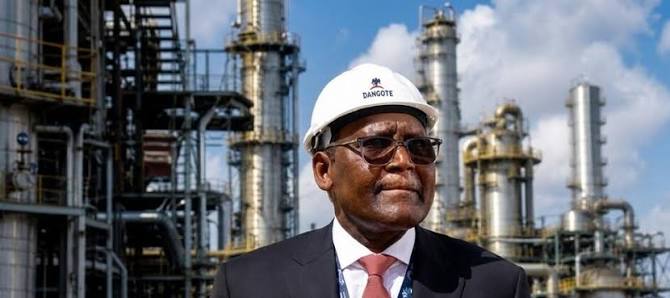

Aliko Dangote has pushed back against opposition to his proposed refinery in Kenya, alleging that local fuel marketers and international oil companies are behind protests surrounding the $16bn project.
The Dangote Group president made the claim as a land dispute continues to create uncertainty around construction of the planned refinery in Lamu.
Dangote spoke during an interview with the BBC’s Focus on Africa programme after he and Kenyan President William Ruto officially broke ground on the project.
The ceremony took place despite a Kenyan court order restricting activities on part of the disputed site.
Some Lamu residents have challenged the project over land acquisition and compensation. Environmental campaigners have also raised concerns about its potential impact on the local community.
Dangote rejected claims that his company had taken more land than was allocated to it. He said the refinery was being developed on land provided by the Kenyan government.
He also questioned the motivation behind the protests, arguing that the refinery would bring significant economic opportunities to the area.
The billionaire described the opposition as “games played by local marketers and international players” and maintained that the project would remain on schedule for completion in 2030.
The planned refinery is expected to process 700,000 barrels of crude oil per day. Dangote said the facility would serve Kenya and other markets across East Africa.
He described the Kenyan project as his biggest proposed investment outside Nigeria and said it would attempt to replicate the success of his refinery in Lagos.
“Lekki proved that it can be done, Lamu must prove that it can be repeated,” Dangote said.
Several African leaders attended the groundbreaking ceremony, including representatives from Uganda, Ethiopia, Togo and Benin. Dangote has also offered regional governments a combined 30 per cent stake in the project.
Despite the launch, opposition to the refinery has continued.
The Save Lamu campaign has questioned the project’s possible environmental consequences. Its co-founder, Walid Ali, said residents wanted access to the environmental impact assessment and details of measures proposed to address potential harm.
The dispute has also moved into the courts.
A group of 133 Lamu residents approached the Kenyan High Court seeking to halt construction. The court has restricted activities such as excavation and construction on the disputed land ahead of a further hearing scheduled for October 14.
Dangote, however, has remained firm on the project.
He said construction could generate about 60,000 jobs at its peak, creating opportunities for residents and businesses in the area.
The refinery complex will also feature a 1,000-megawatt power plant. The facility is expected to provide electricity for Dangote’s operations while supplying excess power to other industries.
With the legal challenge still pending, the Lamu refinery now faces a parallel test: delivering Dangote’s ambitious expansion plans while addressing concerns raised by residents and environmental groups.
SHARE…